Cryptocurrency Investigation
& Blockchain Forensics

c4 Cyber Intelligence Private Limited

Cryptocurrency Crime is a Multi-Billion Dollar Global Problem

Rug pulls. Ransomware. Money laundering. Darknet markets. Human trafficking. Sanctions evasion. Terrorism financing.

Cryptocurrencies now sit at the centre of the world's most serious financial crimes. Yet most investigators, compliance officers, and legal professionals lack the training, tools, and frameworks to effectively detect, trace, and prosecute it.

Cryptocurrency crime is no longer a niche problem. Global crypto scam losses reached a record $17 billion in 2025, powered by AI-generated personas, cross-chain obfuscation, and increasingly sophisticated laundering routes.

Cryptocurrencies now sit at the centre of money laundering, terrorism financing, darknet market activity, drug and weapons trafficking, human trafficking, migrant smuggling, organised cybercrime, illegal gambling, counterfeit goods, wildlife smuggling, sanctions evasion, tax evasion, and unlicensed money transmission.

Rug pulls. Ransomware. Ponzi schemes. DeFi exploits. Exchange hacks. Wash trading. The attack surface is expanding faster than most organisations can track.

A RAND study conducted with the US National Institute of Justice and the Police Executive Research Forum identified 24 critical capability gaps in how law enforcement handles cryptocurrency-related crime.

Top priorities included standardised procedures for seizing and securing crypto assets, two-person verification controls, expanded practitioner training, and stronger inter-agency information sharing.

The study found that most small and mid-sized agencies lack access to effective blockchain tracing tools — and that even open-source solutions require technical expertise and infrastructure beyond the reach of many departments.

Fragmented jurisdiction, limited training, and unclear evidence-handling protocols remain the defining weaknesses across the board.

Most blockchain analytics providers offer powerful software — but software alone does not make an investigator. Their training is designed to teach you how to use their tool, not how to investigate cryptocurrency crime.

Investigators trained only on a vendor's platform are dependent on that vendor's data, that vendor's interface, and that vendor's continued access. When the tool changes, the skill disappears.

Compliance certifications from other providers focus heavily on AML frameworks and regulatory checklists — but leave investigators without the technical depth to trace funds across chains, analyse smart contracts, or handle evidence at a crime scene.

No single provider before c4 has combined deep investigative training, purpose-built operational tools, and a comprehensive forensics manual into one integrated program.

c4 Brochure

The c4 Solution

c4 delivers the world's most comprehensive cryptocurrency crime investigation ecosystem: structured certifications, purpose-built investigation tools, and a 6-volume forensics manual, all under one roof.

Every c4 course is built around the Cryptocurrency Investigation & Forensics Manual and delivered through real case studies, authentic court records, interactive quizzes, and live expert-led sessions.

Learners do not just pass an exam. They learn to think like investigators.

c4's suite of investigation tools covers every phase of a cryptocurrency investigation, from seed phrase recovery and wallet forensics to smart contract analysis, DeFi monitoring, cyber attribution, and field seizure.

The Cryptocurrency Investigation & Forensics Manual is not a product guide. It is a practitioner's framework, legally grounded, operationally tested, and written to support investigations that need to hold up in court.

c4's ecosystem of Career Advisors, Certified Trainers, Authorised Training Centers, and Empanelled Investigators ensures that high-quality cryptocurrency investigation capability can be deployed anywhere in the world.

Who We Serve

Cryptocurrency crime touches every part of the financial and legal system. c4 serves the full range of professionals who encounter it, with certifications, tools, and a forensics manual built specifically for the work they do.

The frontline of cryptocurrency crime investigation, from first response to final verdict.

Who attends:

  • Police officers, cybercrime unit investigators, and digital forensics examiners
  • Financial intelligence units (FIUs) and asset recovery units
  • Tax investigation and revenue intelligence officers
  • Economic offences wings and serious organised crime units
  • Counter-terrorism and proliferation financing units
  • Narcotics and human trafficking task forces
  • Prosecutors, public defenders, and judges
  • Customs and border control officers
  • Intelligence analysts supporting criminal investigations

What c4 gives them:

  • Certifications that build real investigative skill, not just exam passes, through case studies and authentic court records
  • A forensics manual written to support investigations that must hold up in court
  • Investigation tools covering wallet forensics, seed phrase recovery, cyber attribution, and field seizure
  • The capability to trace transactions, attribute wallets, seize assets, and prosecute across ransomware, fraud, darknet, and terror financing cases

The professionals responsible for keeping financial platforms clean and keeping regulators satisfied.

Who attends:

  • AML analysts and anti-financial crime investigators
  • Compliance officers and MLROs (Money Laundering Reporting Officers)
  • KYC and customer due diligence teams
  • Transaction monitoring and sanctions screening analysts
  • Risk managers and financial crime consultants
  • Bank Secrecy Law officers and financial intelligence professionals at banks and fintech firms
  • Fraud investigators at payment processors and neobanks

What c4 gives them:

  • Certifications that map directly to AML, transaction monitoring, and suspicious activity workflows
  • Tools to identify high-risk wallet exposure and trace illicit fund flows
  • A manual framework for filing SARs and STRs backed by structured blockchain evidence
  • The knowledge to meet FATF, Travel Rule, and local regulatory obligations with confidence

Exchanges, custodians, and digital asset platforms operating under growing regulatory scrutiny, with compliance obligations that demand real investigative capability.

Who attends:

  • Centralised exchanges (CEX), spot, derivatives, and margin trading platforms
  • Decentralised exchange (DEX) operators and aggregator platforms
  • Hosted wallet providers and institutional custody services
  • OTC desks, prime brokers, and crypto brokerages
  • Crypto ATM operators and crypto payment processors
  • Stablecoin issuers and reserve management platforms
  • Crypto lending, borrowing, staking, and yield platforms
  • Cross-chain bridge operators and interoperability protocols
  • Prediction markets and on-chain derivatives platforms
  • DeFi protocol operators, liquidity pools, DEXs, and money markets
  • Token issuers, launchpads, and IDO/IEO platforms
  • NFT marketplaces facilitating financial transfers
  • Crypto fund managers and digital asset investment platforms

What c4 gives them:

  • Certifications to upskill compliance and operations teams on blockchain investigation fundamentals
  • Tools for transaction monitoring, on-chain due diligence, and suspicious activity detection
  • A manual framework for responding to law enforcement requests with defensible, court-ready documentation
  • The capability to demonstrate compliance readiness under FATF, MiCA, FIU-IND, and equivalent frameworks

The advisors, auditors, and investigators who handle cryptocurrency when it enters legal proceedings, disputes, or financial crime cases.

Who attends:

  • Lawyers and legal counsels handling financial crime, cybercrime, or asset recovery matters
  • Chartered accountants and forensic accountants
  • Forensic auditors and digital evidence specialists
  • Insolvency practitioners and liquidators handling crypto estates
  • Insurance investigators and loss adjusters
  • Expert witnesses and court-appointed forensic examiners
  • eDiscovery professionals working on cases with blockchain evidence

What c4 gives them:

  • Certifications that develop the ability to read, interpret, and present blockchain evidence in legal contexts
  • A forensics manual grounded in legal frameworks and built for courtroom use
  • Tools for asset tracing, wallet analysis, and transaction reconstruction in disputes and recovery proceedings
  • The capability to handle cryptocurrency evidence, valuations, and fraud investigations with professional authority

The institutions shaping how cryptocurrency is governed and who need to understand it as deeply as the industry they oversee.

Who attends:

  • Financial market regulators and securities commissions
  • Central bank officials and CBDC policy teams
  • VASP supervisory and licensing authorities
  • AML/CFT supervisory bodies and FATF delegations
  • Inter-agency task force members and financial intelligence coordinators
  • Tax policy and revenue authority officials
  • Policymakers developing virtual asset regulatory frameworks

What c4 gives them:

  • Certifications that build independent technical understanding of blockchain investigation methodology
  • A manual that provides the operational grounding needed to evaluate investigations and VASP compliance credibly
  • Tools to independently verify blockchain evidence and assess VASP reporting quality
  • Access to c4's global partner network for cross-border enforcement coordination and capacity building

Builders and security professionals who understand the code and now need to understand what happens when it gets exploited.

Who attends:

  • Blockchain developers and protocol engineers
  • Smart contract auditors and security researchers
  • Web3 security professionals and bug bounty hunters
  • DeFi protocol teams and DAO security committees
  • Penetration testers and red team operators working in crypto environments
  • Enterprise cybersecurity and incident response teams
  • Threat intelligence analysts tracking on-chain adversary behaviour

What c4 gives them:

  • Certifications that add forensic and investigative methodology to existing technical expertise
  • Tools covering smart contract analysis, DeFi monitoring, and cyber attribution
  • A manual framework for tracing fund flows and documenting findings after exploits, rug pulls, or protocol breaches
  • The capability to bridge the gap between technical response and legal or regulatory requirements

Companies holding, transacting, or building on digital assets, navigating a landscape where crypto exposure is a real operational and legal risk.

Who attends:

  • CFOs, treasurers, and finance teams managing digital asset holdings
  • Internal audit and corporate investigation teams
  • Corporate counsel and general counsel handling crypto-related matters
  • Risk, compliance, and governance leads at digitally active companies
  • HR and security teams investigating employee crypto misconduct
  • M&A and due diligence teams evaluating crypto-native acquisitions

What c4 gives them:

  • Certifications to build in-house capability for crypto due diligence and incident response
  • Tools for counterparty wallet analysis, transaction tracing, and internal fraud investigation
  • A manual that provides a structured framework for forensic documentation and regulatory audit readiness
  • Access to empanelled investigators through c4's global partner network when specialist support is needed

Build Real-World Cryptocurrency Investigation Skills

c4 courses are built around the "Cryptocurrency Investigation & Forensics Manual" and delivered through the c4 LEARN platform — with interactive quizzes, deep-dive videos, real court records, and authentic case studies drawn from actual investigations.

CCA is the most comprehensive cryptocurrency crime investigation program.

A c4 Certified Cryptocurrency Crime Analyst works at the intersection of technology, finance, and law enforcement — detecting red flags, tracing illicit fund flows, linking technical evidence to real-world actors, preserving evidence, and translating complex blockchain activity into defensible legal narratives.

Covers all 6 volumes of the Cryptocurrency Investigation & Forensics Manual.

  • Learning Time: 48 hours
  • Fees: INR 60,000 + GST / US$ 699
Details

CCI is a focused, practical certification for investigators who need core blockchain tracing and wallet forensics skills — fast.

CCI covers cryptocurrency wallet investigation and blockchain & cryptocurrency investigation methodologies, combined with hands-on training on c4 investigation tools and real-world tokens.

It is ideal for cybercrime investigators, fraud teams, compliance analysts, and financial investigators new to cryptocurrency.

  • Learning Time: 16 hours
  • Fees: INR 25,000 + GST / US$ 299
Details

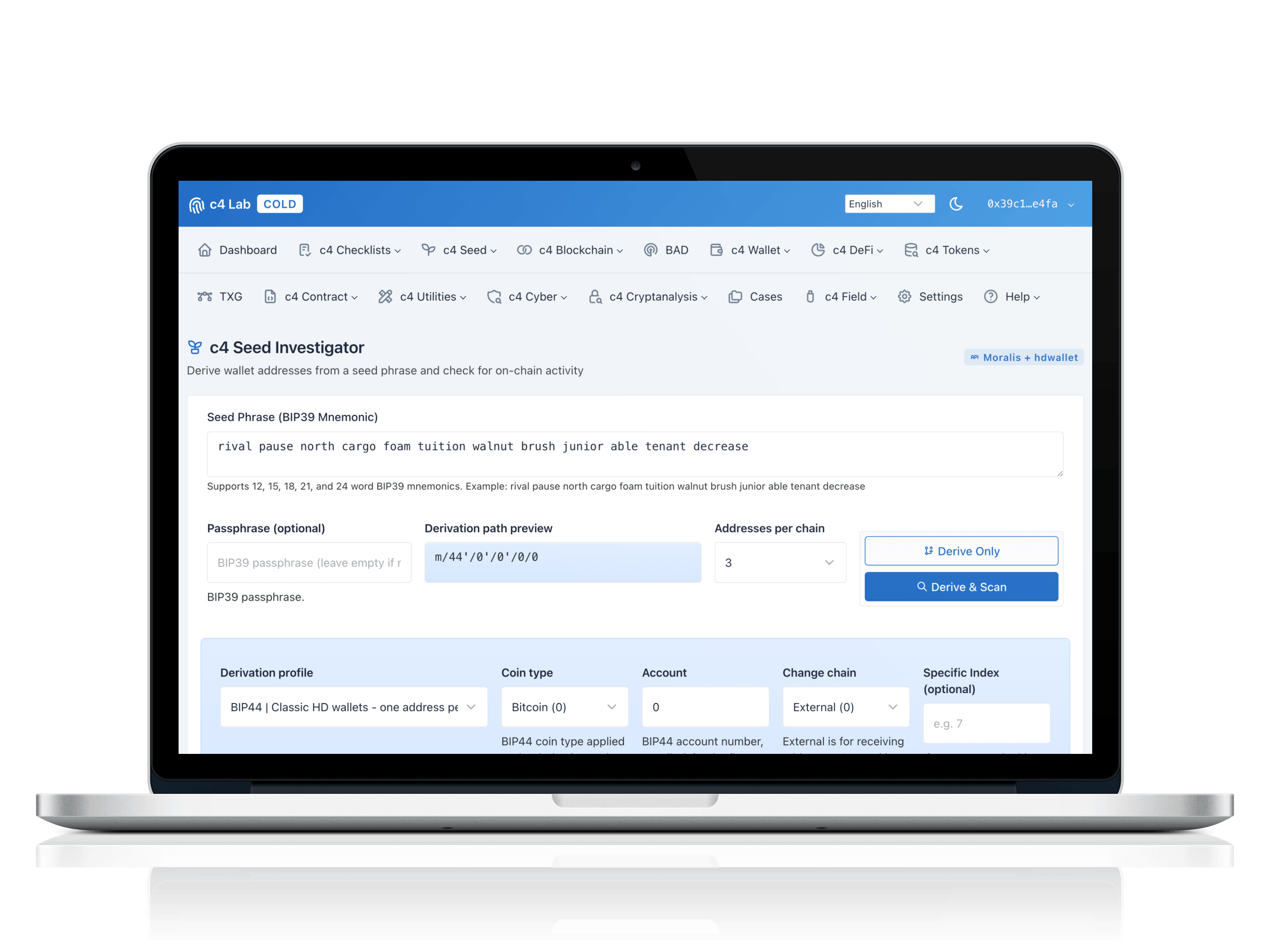
c4 Lab: Cryptocurrency investigation and blockchain forensics platform

Recover and investigate wallets from seed phrases. Derive addresses across multiple derivation paths and analyze associated transaction history.

Deep forensic analysis of cryptocurrency wallets. Identify ownership patterns, transaction clusters, and links to known entities.

End-to-end blockchain transaction tracing. Follow the money across chains, identify obfuscation techniques, and build an evidence trail.

A searchable intelligence database of tagged blockchain addresses — exchanges, mixers, darknet markets, ransomware operators, sanctioned entities, and more.

Investigate specific cryptocurrencies: tokenomics, supply mechanics, known exploits, and on-chain behavior patterns relevant to investigations.

Monitor and investigate decentralized finance protocols. Detect exploits, rug pulls, flash loan attacks, and suspicious liquidity movements in real time.

Analyze token contracts, holder distributions, and transfer patterns. Identify pump-and-dump schemes, wash trading, and fraudulent token launches.

Forensic analysis of smart contracts. Identify malicious code, backdoors, hidden mint functions, and upgrade mechanisms used in crypto fraud.

Link on-chain activity to off-chain digital infrastructure: domains, IP addresses, email accounts, social profiles, and covert communications.

Analyze encrypted data, obfuscated communications, and hidden wallet artifacts found during digital forensic investigations.

Login Pricing

c4 Field: USB-deployable forensic acquisition platform

c4 Field is a USB-deployable forensic acquisition platform built for time-sensitive operations. It captures volatile evidence from live systems before suspects can delete, encrypt, or alter data.

  • Screenshot Capture
  • Clipboard Grabber
  • Process Lister
  • Browser Sessions
  • Wallet Scanner
  • Network Monitor
  • File Finder
  • Memory Strings
  • Memory Dump
  • Android Acquisition
  • Evidence Timeline
Contact Us

Join the c4 Partner Ecosystem

c4 is building a structured, scalable, global partner network. Whether you advise students, deliver training, run a training center, or conduct investigations — there is a role for you.

Guide learners into cryptocurrency investigation careers. Earn a commission for every successful admission. No infrastructure required.

Deliver c4 courses to government, private sector, and academic audiences. Requires formal trainer certification by c4 Academy.

Deliver c4 programs at scale across your region. Access c4's curriculum, brand, certification framework, and expert network.

Apply your expertise to real cases: law enforcement support, corporate investigations, AML probes, and expert consultations.

Contact Us

The World's Most Comprehensive Cryptocurrency Forensics Manual

The Cryptocurrency Investigation & Forensics Manual by Rohas Nagpal is a 6-volume investigative framework covering every dimension of cryptocurrency crime — from wallet forensics to global legal enforcement. It is the backbone of every c4 certification program.

The Cryptocurrency Wallet Investigation Manual covers cryptocurrency wallet forensics, blockchain analysis, and techniques for linking anonymous digital transactions to real-world identities in criminal investigations.

The manual includes practical checklists, hands-on wallet generation exercises, and a complete investigative case study demonstrating how to trace criminal funds across blockchains.

Table of Contents

"Technical Foundations for Digital Investigations" provides trained investigators and forensic professionals with the technical foundation needed to investigate cryptocurrency crime effectively.

The manual includes investigative checklists, red flags, court presentation strategies, and comprehensive coverage of Python libraries for blockchain interaction, digital forensics, malware analysis, browser forensics, and penetration testing.

Table of Contents

"Blockchain & Cryptocurrency Investigation Manual" is a comprehensive field manual for investigating cryptocurrency crime, covering blockchain forensics, DeFi exploits, exchange hacks, money laundering techniques, and ecosystem-specific investigative methodologies multiple blockchains.

The manual includes red flag indicators, behavioral patterns, and actionable checklists designed to help investigators trace funds, establish attribution, identify custodial leverage points, and build legally defensible evidence packages across the full spectrum of blockchain ecosystems.

Table of Contents

The Covert Digital Infrastructure Investigation Manual addresses the infrastructure layer criminals use to resist traditional investigation - from blockchain domains that can't be seized to operating systems that leave no trace.

Rather than attempting to break modern encryption, the manual emphasizes attacking implementation weaknesses, human operational security failures, payment trails, device forensics, and timing analysis - operating on the principle that while the cryptography may be mathematically secure, the humans using it make mistakes.

Table of Contents

"Cryptocurrency Crime Scene: First Responder Manual" provides law enforcement first responders with detailed protocols for handling cryptocurrency-related crime scenes, from initial entry through evidence storage.

The manual includes extensive field checklists, safety protocols to prevent asset drainage, multi-signature wallet handling, DeFi protocol interactions, and specialized procedures for mining operations.

Table of Contents

"Cryptocurrency Enforcement Across The World" provides investigators and legal professionals with jurisdiction-specific guidance on cryptocurrency seizure authority, asset forfeiture procedures, and regulatory compliance across major financial centers.

The manual also addresses complex modern challenges including decentralized finance protocols, cross-border jurisdictional conflicts, privacy coins, smart contract legality, and Central Bank Digital Currencies (CBDCs).

Table of Contents